Online memorial page · one payment
The photographs, the voice
and the stories
stay in the family
One place that holds everything left of them, so the grandchildren know who they were, and so anyone with a memory to add knows where it goes.
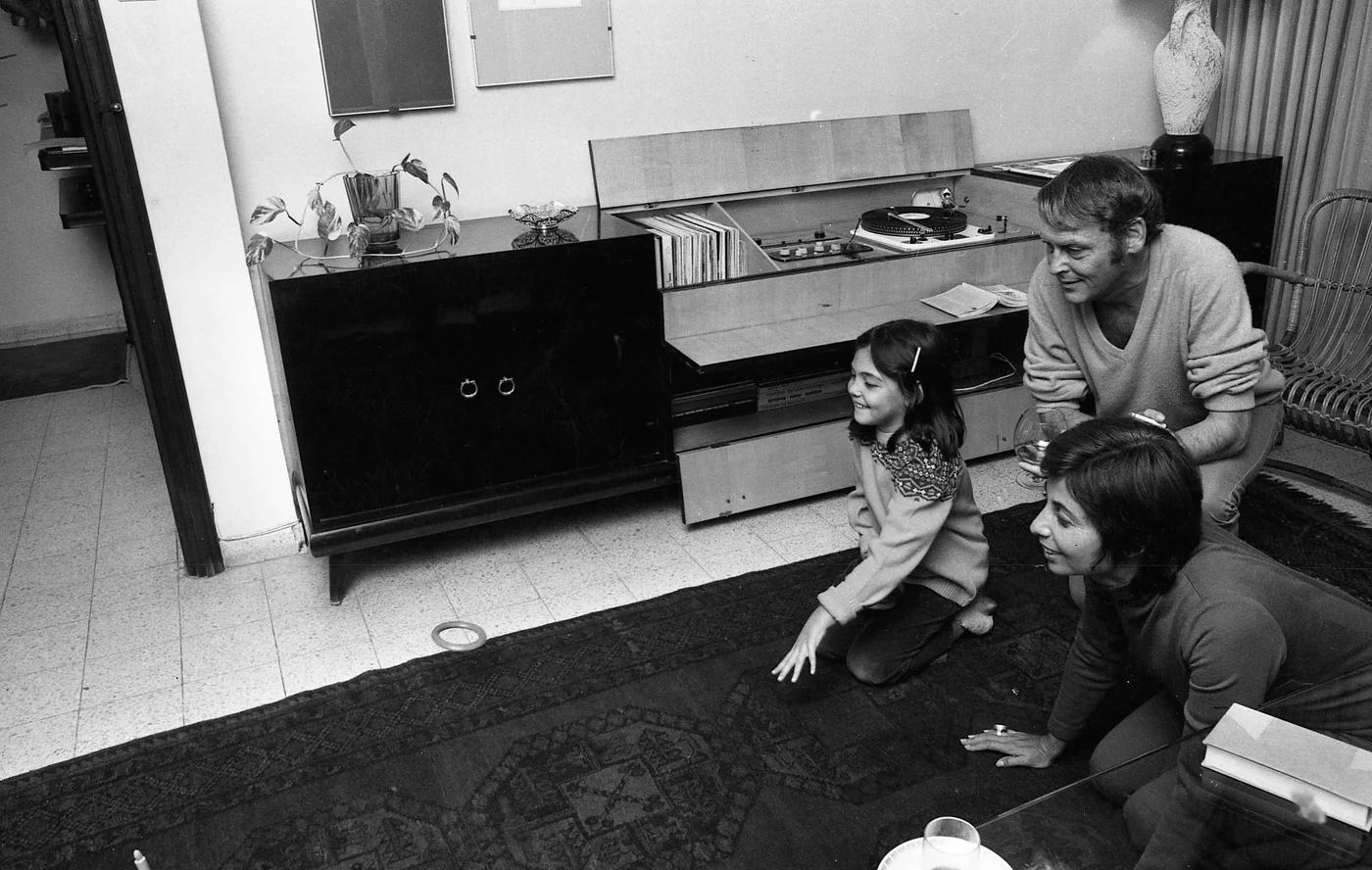
“I was eight and could not read. She sat with me every lunchtime for a term and never once made it feel like a punishment.”
Photographs
a gallery you arrange
The voice
a recording that stays
A life story
the family writes together
Memories
from everyone who knew them
A headstone code
coming soon: scan it and the page opens
“The shoeboxes. One per year, going back to 1951, every letter anyone ever sent her. We found them the week after and none of us could throw a single one away.”
What a family gets
Three things that happen once there is one place
The next generation
The grandchildren will know them
A six-year-old will not remember much. In fifteen years they can hear the voice, see them at their own age, and read what they lived through before they were born, instead of asking and being handed two photographs and a sentence.
For example: ninety seconds of a grandmother telling how they reached Haifa in 1949, in her own voice.
What is scattered
Everything ends up in one place
The photographs are in a box at one sibling’s house, on another’s phone, and in a family group chat that deletes itself. A few years on nobody knows who is in the picture or when it was taken. Here everyone uploads what they have, and it keeps a name and a date beside it.
For example: forty photographs three siblings uploaded together, each with a line saying who is in it and what year.
Everyone who knew them
People with a memory have somewhere to put it
A neighbour, a student, someone from work: each of them has a story the family never heard. Today it is said once at the funeral and ends there. Here it can be sent six months later, with no account to open and nobody to telephone.
For example: a student who wrote about how she stayed behind with him after class every Tuesday, eleventh grade, 1987.
How it works
Fifteen minutes, and no argument with anyone
We do not build the page for you, and we do not ask you to send us materials and wait three days. It is in your hands from the first minute.
- 1
Fill in the details
Name, dates, and your relationship. Two or three minutes, and nothing here has to be final.
- 2
Build the page quietly
It is saved and only you can see it. Add photographs, a story and the moments at your own pace; close it and come back tomorrow.
- 3
Share it with the family
One payment shares it with the family: now you can send the link, and people can come in, add memories and light a candle.
- 4
Decide the rest
Whether it should also appear in Google, choosing the page’s address, other stewards, and soon a code for the headstone. All of this comes once the page is ready.
For example: the example page you can open from here was built exactly this way. A name and dates first, then, one at a time, photographs, a recording, a recipe in her handwriting, and memories people sent in.
A look inside
This is what the page really looks like
These are screenshots of the live product. You can also just open the example page and wander around it.
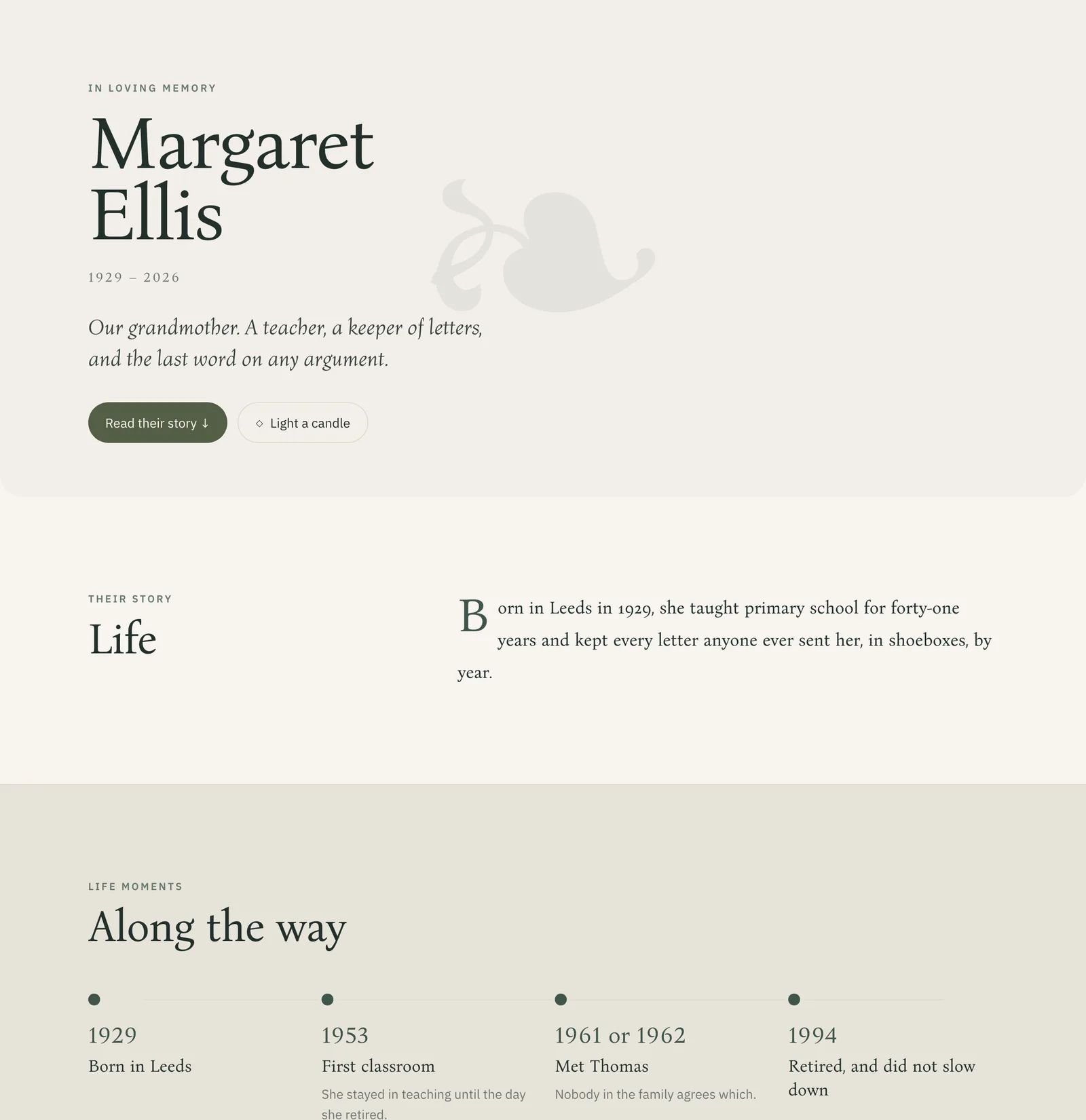
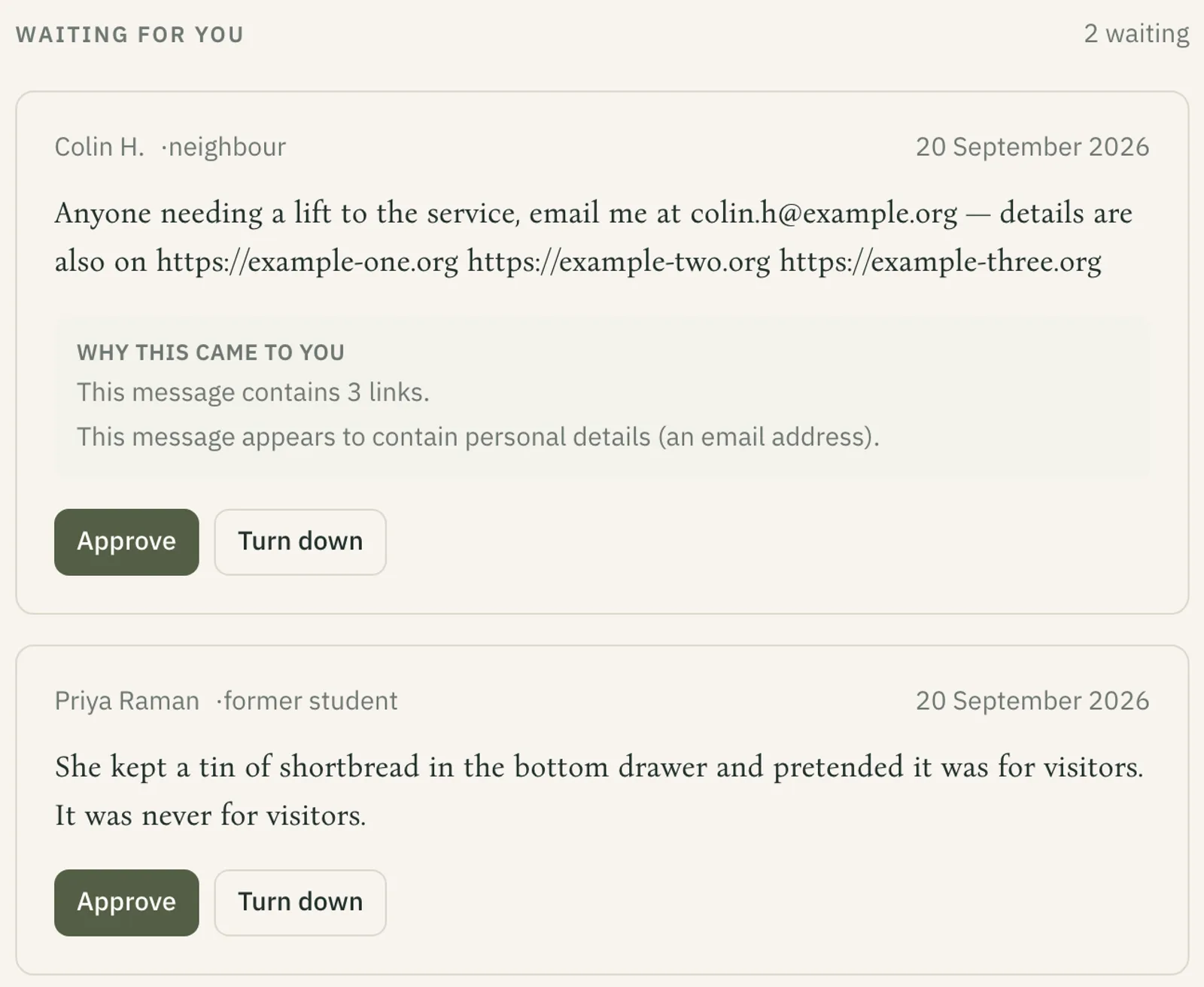
A story, photographs, voices and more
See it all on the example page →- Their storyA life, written by the family together.
- Life momentsFour or five dates that tell a life.
- MemoriesWhat other people are still carrying.
- PhotographsA gallery you choose and arrange.
- Their voiceA recording that was kept. Never autoplays.
- The small thingsA song, a place, a sentence they always said.
On the example page, for instance: her cinnamon cake recipe in her own handwriting, scanned and uploaded as a photograph. Beside it, who bakes it now.
In your lifetime
There are things only you can tell
You can start a page about yourself, while you are alive, and write the story in your own words. It begins entirely private, and you decide which parts the family sees, and when.
When the day comes it does not become a different page. It is the same page, with your voice already inside it.
- What story from your childhood do your children still not know?
- What are you proudest of, even if nobody knows about it?
- What have you changed your mind about over the years?
- What would you want to say to your daughter twenty years from now?
- And more questions. One at a time, and you can always skip.
The code on the headstone · coming soon
Whoever stands at the grave can read the whole story
An engraved aluminium plaque, made for sun and rain, that fixes to the headstone or to a small post beside it. Scan it with a phone and you are on the page. If the plaque is replaced or lost, the code is reissued and the old one stops working.
- No app needed: any phone scans it
- A scan is recorded at city level only: no precise location, no device identifier
- The code can be replaced at any time
Before you trust a service like this
Who controls the page, and what happens if we close
Three questions worth asking any service that holds a family’s material. These are our answers, in one place so the rest of the page does not keep repeating them.
Who runs the page
Whoever opens a page states their relationship, and pays with a card in a real name before it opens to anybody else. That is not proof of kinship. It is a name from a bank and a cost, neither of which an email address gives you. Which is exactly why there is a process: if two people claim the same page, fourteen days are opened in which the kinship is weighed, so it is not settled by who got there first. We will not promise this never goes wrong. We will promise there is a process and someone to go to.
What gets published
This is not a guestbook. What a friend or a relative writes comes to you first, to approve, correct, or decline with wording already drafted. You can mark someone you trust and what they write goes straight up. Spam and phone numbers are stopped before you ever see them.
What happens if we close
Services in this field do not always last: StoryFile filed for bankruptcy protection in 2024, and HereAfter has shut down. Our answer is a button rather than a promise. At any moment, on the free plan too, you can download everything: the original photographs, every word written, and a single file that opens from your computer with no internet and without us.
The export format is open and documented, so somebody else could build a tool that reads it.
Comparison
What is different here
Who can publish a page in the deceased’s name
- With us
- You state your relationship, pay with a card in a real name, and any relative can ask for the page to be handed over
- Usually elsewhere
- Usually anyone with an email address
What happens when a family disagrees
- With us
- A handover request: the steward has 14 days to respond, then our staff decide
- Usually elsewhere
- Usually no written process
Additions from others
- With us
- Reviewed by you, with filtering first
- Usually elsewhere
- Usually an open guest book
Downloading the archive
- With us
- One click, on every plan, including a file that opens in any browser, even offline
- Usually elsewhere
- Not always offered, and not always with the original files
Hebrew
- With us
- A first language, with the Hebrew date and yahrzeit
- Usually elsewhere
- Usually a translation laid over a product built in another language
Payment
- With us
- Once
- Usually elsewhere
- Usually a recurring subscription
Based on the published terms and help pages of the larger services in this field, as of September 2026. Services change and they do not all work the same way, so it is worth checking for yourself before you choose.
Pricing
You pay once. That is all.
The free plan keeps everything and deletes nothing, but the page stays private: only you can see it, even if someone has the link. One payment opens it to the family and to anyone you send the link to.
Free
$0
no card needed
To start, and to see whether it suits you.
- One memorial page
- Private: only you can see it
- Up to 30 photographs
- Full archive download
Memorial page
$39
One payment · no renewal fee
So the page can be sent at all and, if you choose, found by people without the link too: a distant cousin, a friend from the army, a grandchild in twenty years.
- The page is shared with the family: you can send it, and people can come in, add a memory and light a candle
- If you choose, anyone searching the name finds the page, years from now too
- Unlimited photographs
- An address for the page that you choose, to put in a message or on a memorial notice
- More stewards from the family, and an archive of the page emailed to you once a year
Memorial page + QR
With the engraved plaque for the headstone (coming soon). A page opened now can have it added when it arrives, paying only the difference.
- Everything in the memorial page
- An engraved aluminium plaque, 5×5 cm, with the name and the code
- Posted to the address you give; postage included within Israel
- Fixing it to the headstone is done by the monument maker, not by us
- The page behind the code can be changed at any time, without a new plaque
- A damaged plaque or a faulty engraving is replaced free
For funeral homes, burial societies and monument makers, there is a partner plan with pages set up in advance. Talk to us.
Questions
What people usually ask
How is this different from a Facebook memorial page?
Facebook can turn the account of someone who has died into a memorialized account, or you can start a group. A memorial page here is made for remembering: the story, photographs and recordings in one place, memories from others appear only when you approve them, there are no ads, and you can download everything at any time. Many families use both.
Is it free to create a memorial page?
Yes. You create and fill in the page for free, and it stays private: only you can see it. To open it to others, so they can read it, leave a memory and light a candle, you pay once. No subscription, nothing to renew.
What if someone else in the family opens a page for the same person?
Before publishing we check whether a public page already exists with a similar name and date of death, and offer to join it rather than run two pages in parallel. If they really are two different people, you can continue, and that is recorded.
And what if there is a dispute about who runs the page?
A relative can ask for the page to be handed to them. The current steward is told at once and has 14 days to respond, and until it is settled the page cannot be deleted or made more visible. Our staff decide, starting from an order of kinship. A will, an executor or a court order comes first. Where it cannot be settled, the page is frozen, and its stewards can still download the archive.
Do I need an account to write a memory?
No. A written memory needs your name; an email address is optional, and is used only to tell you whether the memory was published. It is never shown on the page and never used for anything else. You need to be 16 or over.
My photographs contain location data. Will that be published?
No. Location data embedded in photographs is stripped from every upload, always, with no way to turn it off. People upload family photographs without knowing they carry the address of the house.
How does this work with the Hebrew date and the yahrzeit?
It is a switch on the page, on by default when the page is written in Hebrew and available in every other language, because whether a family keeps the yahrzeit has nothing to do with which language they read in. With it on, the Hebrew date is worked out from the Gregorian one, including the change of day at sunset and leap years with two months of Adar, and you can still correct it by hand. The reminder comes a week before.
Can I download everything and leave?
Yes, at any moment and on any plan. You get a ZIP with the original photographs, a documented data file, and a page that opens in any browser, no internet needed. Even if the page is frozen by a dispute, the export stays available.
Ready to begin?
It takes about fifteen minutes. The page is created private, and you decide when, and whether, to publish it.